
Pro Guide for Beginners
How to Find Your
Perfect Foundation Shade
You've stood in front of 40 shades, tested three on your hand, and still walked away unsure. This guide fixes that — with the same approach professional makeup artists use, simplified so you can apply it instantly.
Understand the 3 Things That Actually Matter
Most guides talk about two things. In reality, three factors determine a perfect match:
Depth
How light or dark the foundation is. Ranges from fair to rich.
Undertone
The subtle colour beneath your skin.
- Warm — yellow, golden, peach
- Cool — pink, red, bluish
- Neutral — balanced mix
- Olive — green/grey cast
Overtone
What your skin currently looks like. This is what most beginners ignore.
Changes with sun exposure, hyperpigmentation, redness, or hormones. Always match what you see — not what theory says.
Olive undertones are especially common in South Asian, Mediterranean, and Middle Eastern skin tones. If foundations often look too orange or too pink on you, olive is very likely.
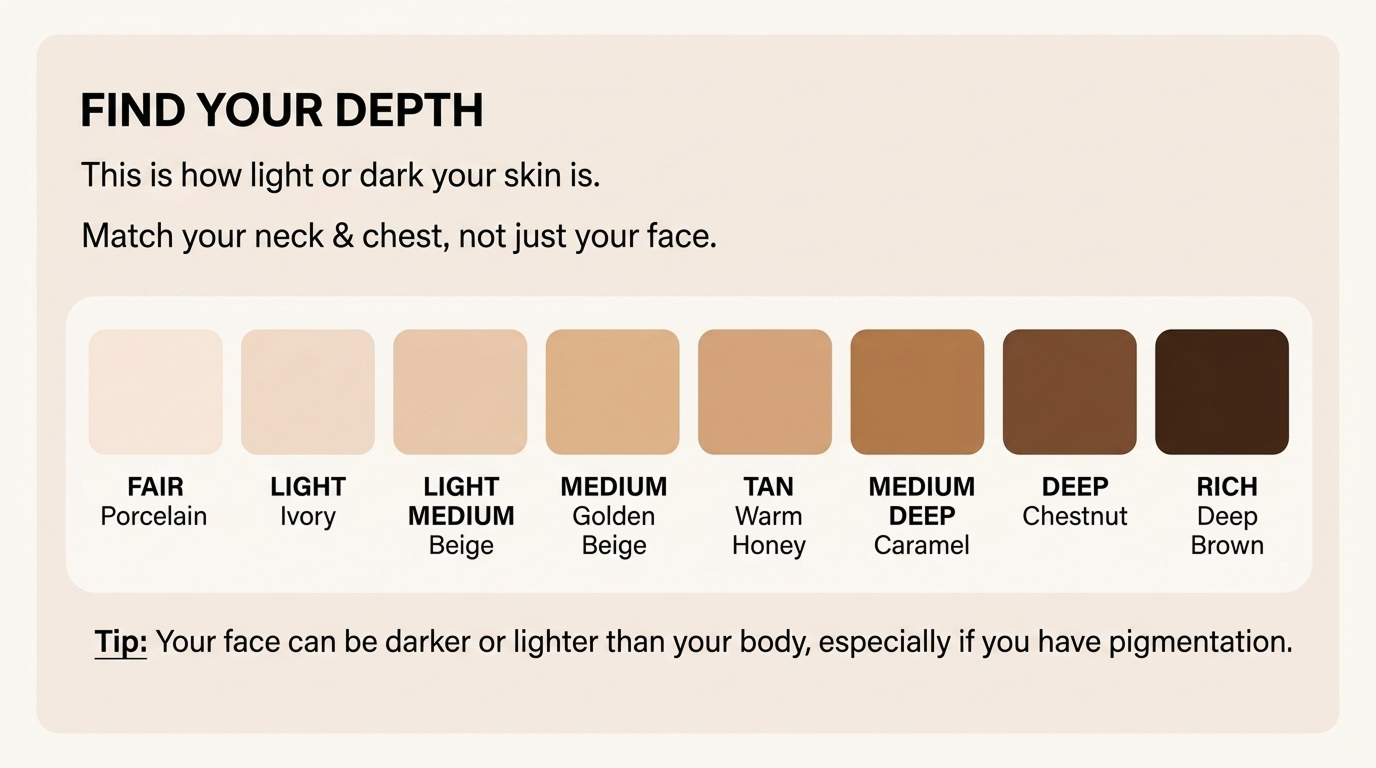
Find Your Depth
Use this only to narrow options — not to pick your exact shade.
In natural daylight, hold your arm next to a white piece of paper and estimate your range (e.g. medium, tan, deep). This reduces 40 shades down to roughly 8–10 options.
Identify Your Undertone
No single test is perfect. Combine a few.
Jewellery test
most reliable- Gold looks better — warm
- Silver looks better — cool
- Both work — neutral
- Neither looks quite right — possibly olive
Foundation look test
- Looks orange — too warm
- Looks pink — too cool
- Looks grey or ashy — wrong undertone (often an olive issue)
Vein test
less reliable- Green veins — warm
- Blue or purple — cool
- Hard to tell — neutral or olive
Less reliable for medium to deep skin tones.
Clothing test
- Pure white looks best — cool
- Cream or off-white — warm
- Both work — neutral
Where to Match
This is where most people go wrong.
Do not match to
- Your hand
- The darkest part of your face
- Your inner wrist
Always match to
- Your jawline
- Check against your neck and chest
Your face may be darker from hyperpigmentation or sun exposure. Your neck is your true baseline. A correct match should blend seamlessly from face to neck.
Swatch Like a Pro
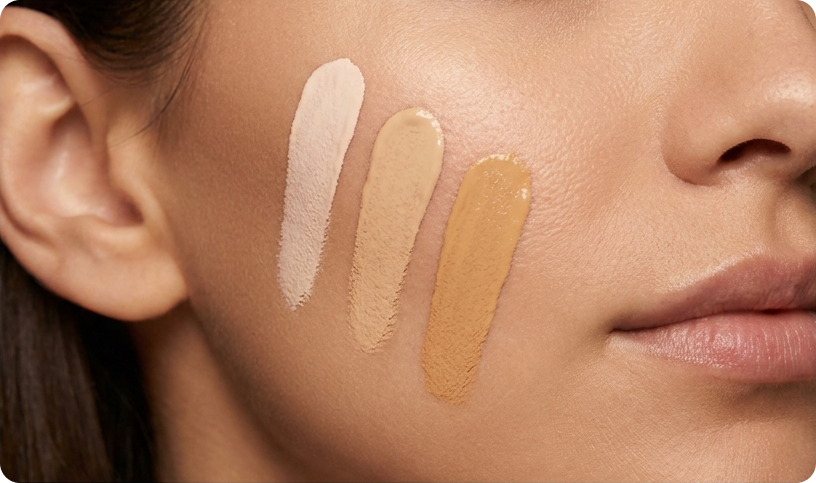
In-store, apply three shades along your cheek and jawline (not your hand):
- One you think is right
- One slightly lighter
- One slightly darker
Check in natural light — step outside if possible. Then wait 5–10 minutes, because some foundations oxidise and darken over time.
The correct shade will "disappear" into your skin, have no visible edge, and match both face and neck.
Already have a shade you love? Skip to finding matches
What If Nothing Matches Perfectly?
This is normal — even for professionals.
Mix shades
Use one lighter and one darker. This is the most accurate method.
Adjust undertone
Too orange? Add a tiny bit of blue or olive mixer. Too pink? Add a yellow or golden mixer.
Choose slightly lighter
Then add warmth using bronzer or contour. This often looks more natural than going too dark.
Formula Matters Too
Even with a perfect shade, the wrong formula can look off.
- Oily skin — matte or soft-matte
- Dry skin — hydrating or dewy
- Texture or acne — avoid heavy cakey formulas
Shade plus formula equals your final result.
Seasonal Shade Changes
Your skin tone can shift throughout the year. Summer tends to be deeper and warmer; winter tends to be lighter and cooler.
Many people need two shades per year, or mix between them during transitions.
Special Situations
Hyperpigmentation or acne marks
Match your overall skin tone, not dark spots. Correct those with concealer later.
Olive undertones
Look for shades labelled "olive", "neutral olive", or with muted yellow-green tones. Avoid strong orange or pink bases.
Deeper skin tones
Watch for ashiness (too grey) and over-red foundations. Look for brands with true undertone diversity, not just darker depth.
Use Your Match as a Reference
Once you find a shade that works, use it as a baseline to compare across brands. Look for the same depth level and undertone family. This makes future shopping much faster.
That's exactly what MakeupMatch does.
Give us one shade you love, and we'll find your match across every brand we carry.
Find Your MatchQuick Reference: Shade Codes
W
Warm
C
Cool
N
Neutral
O
Olive
Examples: "4W" means depth 4, warm. "185N" means neutral. "NC30" is a brand-specific warm-neutral code.
The Golden Rule
If the shade is correct,
you shouldn't see it.
It should look like your skin — just more even, smoother, and healthier.
Shade matching isn't about memorising rules — it's about training your eye. Once you understand depth, undertone (including olive), and where to match, you'll never feel overwhelmed by a shade range again.